|
Getting your Trinity Audio player ready...
|
TL;DR: Strong employee retention strategies, like competitive compensation, career development, recognition, flexible work arrangements, and a positive company culture; boost engagement, reduce turnover, and enhance overall employee experience, keeping top talent committed and productive.
Effective employee retention strategies are essential, with employee disengagement costing the world economy about USD 8.8 trillion in lost productivity.
Based on a report, global employee engagement declined to 21% in 2024 from 23%. This proves that organizations should treat retention as a strategic business imperative. It has a major impact on profitability, employee morale, and long-term stability.
Why Employee Retention Strategies Matter Now More Than Ever
The workplace landscape has shifted dramatically. Few things frustrate business leaders more than investing in employees, only to watch them leave soon after. High turnover disrupts productivity, lowers morale, and significantly raises recruitment costs, creating long-term challenges for any organization’s stability and growth.
Higher employee engagement delivers measurable advantages:
These figures highlight why strong employee retention strategies are essential. Disengagement represents lost income opportunities most businesses simply cannot afford to ignore.
The following proven retention tactics show how successful organizations maintain top talent while driving consistent business performance.
Related post: What is Workforce Management? Tools, Models, and Metrics
Quick Insights
- Prioritize competitive pay and personalized benefits for retention
- Offer clear career paths with mentorship and learning opportunities
- Recognize achievements consistently to drive engagement and loyalty
- Provide flexible work arrangements and wellness initiatives
- Use technology and feedback to strengthen employee experience
Top 10 Employee Retention Strategies
1. Reimagine Your Compensation Package
While competitive pay remains essential, modern rewards packages must evolve beyond salary to address diverse employee needs and expectations.
Research shows 42% of employees would trade salary for better benefits, while 63% prefer more personalized reward options.
Your compensation approach should include:
- Competitive base pay aligned with industry benchmarks
- Performance-based incentives connected to company goals
- Flexible benefits employees can customize
- Financial wellness programs and retirement planning
Determine what your specific talent pool values most through research, then adjust accordingly to maximize satisfaction and retention.
2. Invest in Career Development Opportunities
Many employees leave jobs because they lack opportunities to grow. Retention tactics include:
- Clear career paths with milestone achievements
- Personalized learning and development plans
- Mentorship and coaching programs
- Tuition assistance for continuing education
- Cross-training across departments
Scaling a business with skilled professionals requires creating growth opportunities that keep your best people engaged and committed.
3. Foster Meaningful Recognition
Recognition drives engagement and retention. A study notes 78% say recognition impacts retention positively.
Effective recognition programs should:
- Celebrate both individual and team achievements
- Provide timely, specific praise linked to company values
- Enable peer-to-peer recognition
- Offer meaningful rewards employees value
- Make recognition consistent, not occasional
Recognition requires minimal cost but delivers significant impact on morale and loyalty.
4. Prioritize Work-Life Balance
Employees with healthy work-life balance show greater productivity and stronger loyalty. Hybrid work is now a business standard, not a trend.
Employee retention strategies here include:
- Flexible scheduling options
- Remote or hybrid arrangements
- Policies respecting off-hours
- Generous paid time off
- Family-friendly benefits and parental leave
Wellness initiatives addressing physical, mental, and financial health help create a holistic approach to employee well-being.
5. Create a Positive Company Culture
Culture can retain employees even during challenging times. To strengthen culture:
- Define and live your core values daily
- Promote transparency and open communication
- Build diverse, inclusive teams
- Foster psychological safety
- Encourage collaboration and innovation
6. Revamp Your Onboarding Experience
First impressions matter. Gallup reports only 12% of employees strongly agree their organization excels at onboarding new hires.
Modern retention tactics for effective onboarding include:
- Extending onboarding beyond the first week
- Assigning mentors to new hires
- Creating 30-60-90 day success plans
- Scheduling check-ins during the first year
- Gathering feedback for improvement
A positive onboarding process sets the tone for the employee’s long-term experience.
7. Leverage Technology for Engagement
Technology can boost your employee retention strategies by creating personalized, efficient experiences.
Consider implementing:
- Employee experience platforms
- Recognition and rewards software
- Pulse-survey feedback tools
- Learning management systems
- Communication and collaboration tools
When used thoughtfully, technology strengthens workplace connections, even in hybrid and remote environments.
8. Provide Meaningful Feedback
Regular, constructive feedback fuels employee growth.
Best practices include:
- One-on-one development-focused meetings
- 360-degree feedback opportunities
- Real-time recognition and coaching
- Growth-oriented performance reviews
- Clear communication of expectations and goals
9. Empower Middle Managers
Middle managers are the bridge between leadership vision and frontline execution.
Strengthen your management tier by:
- Providing leadership development tailored to managers
- Equipping them with tools that support team wellbeing
- Training them to hold meaningful career conversations
- Recognizing managers who excel at retention
- Creating communities of practice for sharing successful retention tactics
Scaling a business is challenging. From rising operational costs to finding skilled professionals, growth can face roadblocks. Empowering managers strengthens employee retention strategies and helps overcome these challenges.
10. Measure What Matters
You can’t improve what you don’t measure. Use these metrics to evaluate employee retention strategies:
- Overall retention rate (compare to industry benchmarks)
- Regrettable turnover (loss of top performers)
- Employee Net Promoter Score (eNPS)
- Engagement survey results
- Exit interview insights
- Time-to-fill for open positions
- Cost-per-hire and replacement expenses
Regular “stay interviews” with valued employees provide insights before issues escalate, unlike exit interviews which come when it’s already too late.
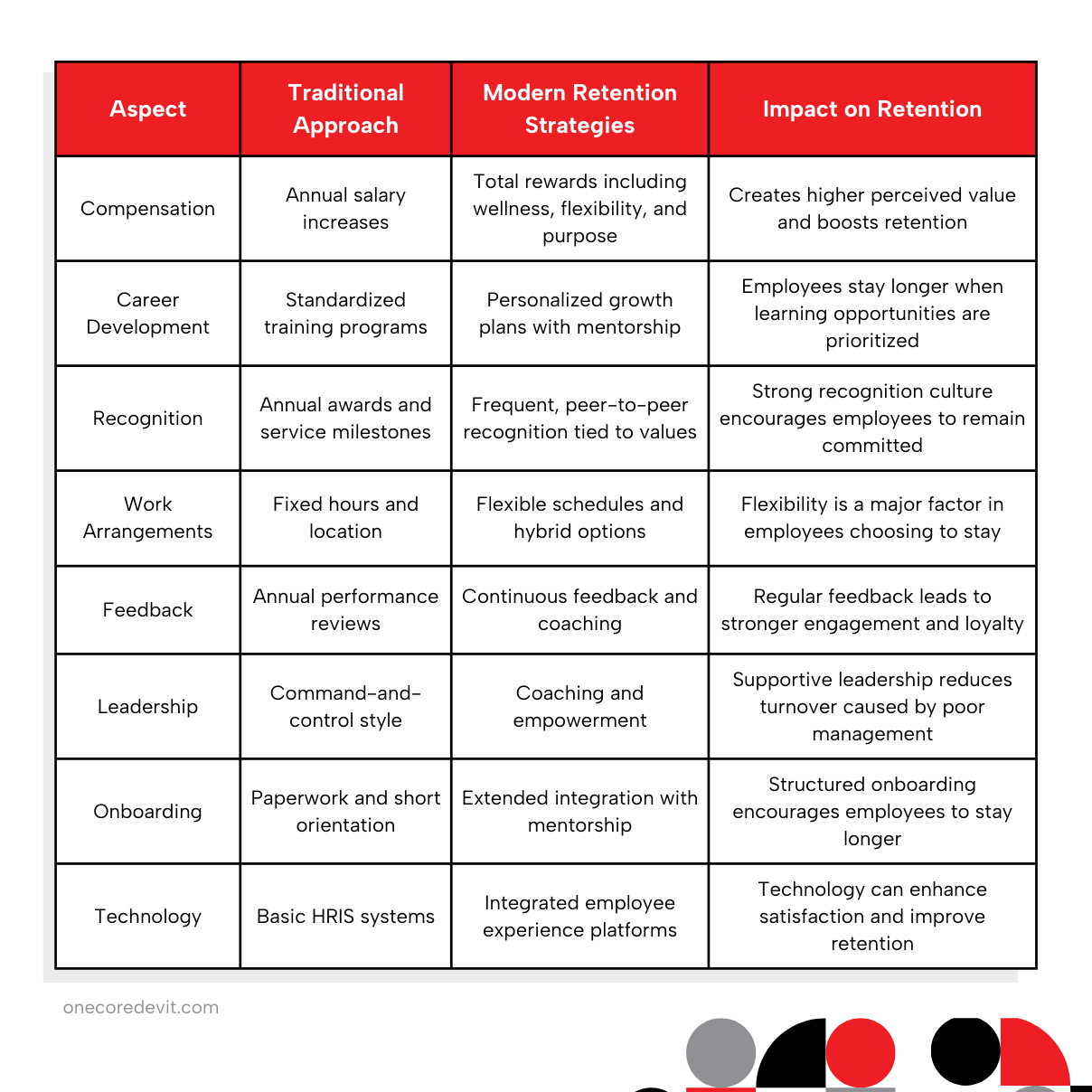
Comparing Traditional vs. Modern Retention Tactics
Today’s workplace demands rethinking employee retention strategies, replacing outdated perks with modern, data-informed approaches that strengthen satisfaction and long-term commitment.
Implementing Employee Retention Strategies for Different Workforce Segments
One size doesn’t fit all for employee retention strategies. Each workforce segment has unique motivators, priorities, and engagement drivers.
Early Career Professionals
Provide rapid skill development, structured mentorship, and clear advancement paths. Learning and development consistently ranks among the top three reasons why gen Zs and millennials choose their employers.
Mid-Career Specialists
Emphasize work-life balance, recognition for expertise, and opportunities to lead projects or mentor others. These employees value flexibility and seeing the impact of their work.
Senior Leaders
Provide strategic challenges, autonomy, and opportunities to shape organizational direction. Executive retention often hinges on alignment with company vision and values.
Remote Workers
Create intentional connection points, ensure equity in advancement opportunities, and provide the right tools and technology. The shift toward remote work and global teams requires specific retention tactics.
Related post: Talent Acquisition vs Recruitment: Understanding the Difference

Building a Retention-Focused Organization
Implementing effective employee retention strategies goes beyond preventing turnover. It’s creating a workplace where employees feel valued and supported daily. When employees trust leadership and see career growth opportunities, they are more likely to stay and give their best work.
A strong retention approach considers culture, communication, benefits, and growth, making it easier for employees to thrive and contribute fully.
Prioritizing the employee experience means focusing on every stage of their journey, from onboarding to career advancement and even exit feedback. Consistent recognition, skill development programs, and transparent communication all contribute to a positive environment employees are proud to be part of. When people feel heard and valued, they naturally become more engaged, motivated, and committed to long-term success with the organization.
Retention thrives when engagement strategies are integrated into daily practices and leadership actions at every level of the company.
- Executives must set a clear, inspiring cultural tone that promotes trust, inclusion, and accountability.
- Managers should actively support team development through coaching, recognition, and creating opportunities for meaningful work.
- HR professionals can design policies and programs that align business needs with employee well-being, ensuring long-term satisfaction and retention.
Investing in retention produces measurable results, such as higher productivity, stronger customer relationships, and reduced hiring costs. Its benefits extend beyond financial gains, fostering a workforce that is collaborative, innovative, and aligned with company goals.
As the workplace evolves, employee retention strategies must adapt to changing employee expectations, industry shifts, and emerging work trends. Remember, organizations that innovate in retention and engagement will remain competitive in attracting and keeping the best talent.
Frequently Asked Questions (FAQs)
Q1: What are the most cost-effective retention tactics for small businesses?
Small businesses can focus on creating a strong culture, providing flexibility, recognizing contributions, and offering growth opportunities. These strategies often cost less than formal programs but yield significant results in retention.
Q2: How do employee retention strategies differ for remote vs. in-office teams?
Remote teams require more intentional communication, structured check-ins, virtual team-building, and technology that facilitates collaboration. In-office strategies can leverage physical proximity but should still include flexibility options.
Q3: What role does compensation play in modern retention strategies?
While competitive pay remains important, research shows that compensation alone won’t retain top talent if other engagement factors are missing. The total employee experience, including purpose, growth, and recognition, often outweighs salary considerations.
Q4: How can we measure the ROI of our employee retention strategies?
Calculate the cost of turnover (including recruitment, onboarding, lost productivity) and compare it to retention program investments. Track improvements in retention rates, performance metrics, and engagement scores to demonstrate ROI.
Q5: What are the warning signs that an employee might leave?
Watch for decreased engagement, reduced productivity, withdrawal from team activities, increased absenteeism, and a shift in attitude. Regular pulse surveys and check-ins can help identify these warning signs early.
Q6: What are the 5 C’s of retention?
The 5 C’s of retention typically refer to Clarity, Connection, Contribution, Career, and Compensation. They emphasize providing clear expectations, building strong relationships, ensuring employees see their impact, offering growth opportunities, and rewarding fairly. Together, these factors create a supportive and motivating work environment.
Q7: What are the strategies for employee retention?
Effective retention strategies include offering competitive pay, providing career development opportunities, recognizing achievements, fostering a positive work culture, and promoting work-life balance. Regular feedback and open communication also help employees feel valued and engaged. These approaches reduce turnover and boost loyalty.
Q8: What are the 4 pillars of retention?
The 4 pillars of retention are often Engagement, Growth, Recognition, and Well-being. Engagement keeps employees emotionally invested, growth ensures they see a future in the company, recognition validates their contributions, and well-being supports their mental and physical health. Balancing these pillars creates long-term commitment.
Retaining top talent isn’t just about competitive salaries; it’s about building lasting relationships and fostering a culture where people want to stay. CORE® goes beyond the standard retention playbook, offering tailored strategies and employer of record services that remove the complexity from hiring in the Philippines. We ensure compliance, streamline onboarding, and deliver continuous support so you can focus on growth. By linking global companies with skilled Filipino professionals, we create opportunities for innovation and shared success. Contact us today!