|
Getting your Trinity Audio player ready...
|
TL;DR: The US accountant shortage is not affecting every finance role equally. The hiring pressure is concentrated in specialized accounting positions where experience, technical knowledge, and operational judgment are hardest to replace. For CFOs, addressing the gap requires understanding which roles are most constrained, evaluating when to expand into an offshore accounting talent pool, and building the offshore accounting governance needed to sustain performance.
Your controller requisition has been open for four months.
Two candidates withdrew midway through the hiring process.
For many CFOs, the accountant shortage is no longer an industry headline. It’s an operational constraint that delays hiring, stretches finance teams, and leaves critical positions vacant despite continued recruiting efforts.
The United States is facing a significant shortage of accountants driven by multiple workforce trends. Experienced professionals continue to retire, the accounting graduate shortage has reduced the number of new entrants into the profession, and the CPA candidate decline has narrowed the pipeline of licensed accountants. At the same time, demand for financial reporting, audits, and regulatory compliance remains strong, leaving organizations competing for a limited supply of qualified talent.
Recent data shows that this experience is no longer isolated. The Controllers Council‘s 2026 Corporate Finance & Accounting Talent Study found that finance leaders now characterize the market as a talent shortage, with sentiment shifting from a 108% Talent Surplus Index in 2025 to a 77% Talent Shortage Index in 2026. At the same time, hiring demand has returned to pre-pandemic levels, increasing competition for experienced accounting professionals.
More importantly, hiring pressure is no longer distributed evenly across accounting roles. Accounting professor Jack Castonguay of Hofstra University described this shift in an August 2025 interview with CFO Dive as a role-based accounting shortage, rather than a profession-wide one. That changing distribution of hiring pressure reflects a deeper problem: fewer accounting professionals are entering the workforce. Understanding how this structural shift is reshaping hiring priorities is becoming just as important as recognizing the shortage itself.
Related post: Accounting Talent Shortage: A Guide to Offshore Talent Strategy
The Pipeline Behind the Accountant Shortage
The accounting talent shortage is rooted in a pipeline that has been shrinking for years.
Data highlights a massive disconnect within the profession. According to the NASBA 2024 Report, only 27,994 first-time candidates sat for the CPA exam. Meanwhile, the AICPA 2025 Trends Report notes that universities turned out to be 55,152 accounting graduates in the 2023–24 school year.
That distinction matters because it proves the industry is losing talent after graduation, with roughly 50% of degree-holders opting out of the CPA path. Because the pool of certified professionals is objectively shrinking, traditional recruitment tactics have hit a wall. Higher salaries or faster hiring timelines might help you win a candidate from a competitor, but they do not create new accountants.
Finance leaders must look past simple recruiting metrics. The real mandate is designing a sustainable operational strategy that can function despite a structurally limited talent supply.
Quick Takeaways
- The accounting labor market shifted from a reported talent surplus in 2025 to a talent shortage in 2026.
- The accountant shortage is concentrated in roles that require specialized experience, including financial reporting, technical accounting, senior accounting, and controller-track positions.
- A CPA candidate decline and changes in the accounting talent pipeline contribute to longer-term supply constraints, while increased hiring demand has intensified competition for experienced professionals.
- Evaluate accounting roles individually rather than applying a single hiring strategy across the finance function. Some roles may remain viable for local hiring, while others may require broader talent access.
- An offshore accounting talent pool can expand sourcing options for difficult-to-fill roles, but success depends on clear workflows, ownership structures, and offshore accounting governance.
- Offshore hiring is not only a staffing decision. It is an operating model decision that requires defined reporting lines, quality controls, and ongoing collaboration.
Where the Role-Based Accountant Shortage Is Concentrating
The role-based accounting shortage is becoming most apparent in positions that require technical expertise, professional judgment, and ownership of critical accounting processes. Hiring pressure is increasingly concentrated among professionals responsible for financial reporting, technical accounting, regulatory compliance, and other specialized finance functions.
Mid-Level and Technical Accounting Roles Face the Greatest Pressure
Labor market trends reinforce this shift. The U.S. Bureau of Labor Statistics projects approximately 124,200 accountant and auditor openings each year between 2024 and 2034. Meanwhile, employment for bookkeeping, accounting, and auditing clerks is projected to decline overall, although replacement demand will continue to generate substantial annual openings.
These projections reflect changing demand across accounting functions. As organizations automate more routine accounting activities, employers are competing for professionals who can independently manage complex accounting responsibilities. This includes senior accountants, financial reporting analysts, technical accountants, and specialists with experience in financial reporting, audit support, regulatory compliance, and accounting standards.
This difference explains why the accountant shortage is increasingly concentrated in roles that require specialized knowledge and decision-making experience rather than affecting all accounting positions equally.
Why Role-Level Scarcity Matters
Vacancies in these positions can create operational strain across finance teams. Unlike routine accounting tasks, technical and mid-level accounting responsibilities often require experience that cannot be quickly transferred across existing teams without increasing workload or creating additional reporting and compliance risks.
Unfilled roles can delay financial close processes, increase review responsibilities for controllers and senior accountants, slow audit preparation, affect regulatory reporting timelines, and reduce finance teams’ capacity to support forecasting and strategic initiatives.
For CFOs, the challenge is identifying which accounting capabilities create the greatest operational risk when left unfilled. As hiring conditions remain competitive, workforce strategies must prioritize continuity in roles that have the greatest impact on financial accuracy, compliance, and decision-making.
As organizations evaluate options to address these gaps, access to a broader offshore accounting talent pool can provide additional capacity for appropriate finance functions. However, this approach requires strong processes, quality controls, and offshore accounting governance to maintain consistency and operational visibility.
How CFOs Can Evaluate Roles for Offshore Accounting Support?
The accountant shortage does not mean every open accounting role should move offshore. For CFOs, the decision should start with understanding the role’s complexity, business impact, process maturity, and long-term workforce needs.
As the role-based accounting shortage continues to affect specific finance functions, organizations need to evaluate which positions require broader access to talent and which roles are better addressed through local hiring, process improvements, or other workforce strategies.
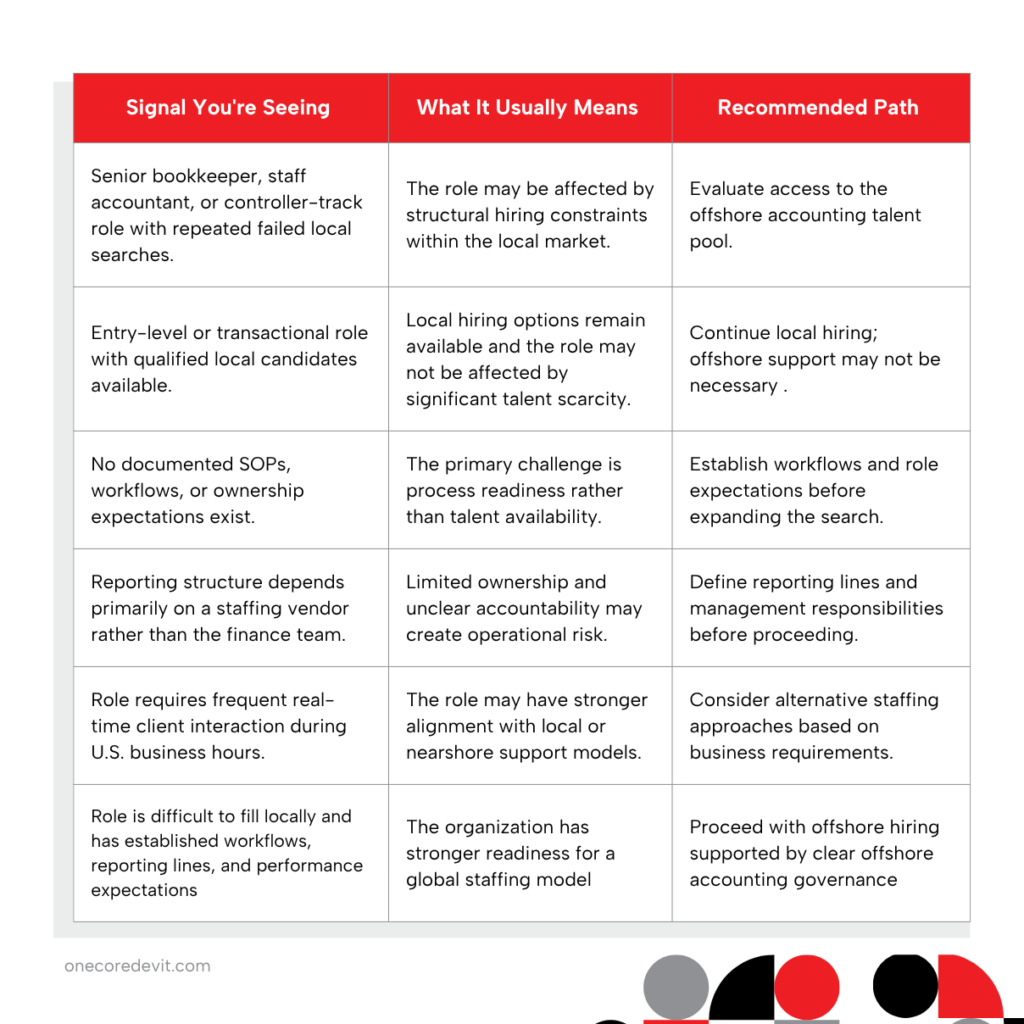
The key consideration for CFOs is that offshore hiring addresses access to talent, but it does not replace operational discipline. Clear workflows, defined ownership, performance expectations, and communication processes determine whether an offshore model can support finance operations effectively.
Strong offshore accounting governance helps maintain visibility, accountability, and consistency across distributed finance teams. Without these foundations, expanding the talent search may only move the sourcing challenge into a different operating model.

Why Offshore Accounting Governance Matters for CFOs
Expanding into an offshore accounting talent pool can give finance teams access to additional capacity, but sustainable results depend on how the model is structured and managed. For CFOs, the question is not only where accounting work is performed, but whether the operating model supports accuracy, accountability, and long-term scalability.
Strong offshore accounting governance creates the framework that allows distributed finance teams to operate effectively. It establishes clear ownership, reporting structures, quality standards, and communication processes that help maintain consistency across accounting functions.
Key elements of effective offshore accounting governance include:
- Defined ownership and reporting lines: Offshore team members should have clear responsibilities and direct alignment with finance leadership rather than operating as an isolated support function.
- Documented processes and SOPs: Standardized workflows help ensure accounting tasks are performed consistently and reduce dependency on individual knowledge.
- Quality controls and review processes: Regular reviews, reconciliation procedures, and performance monitoring help maintain accuracy across financial operations.
- Secure access and compliance practices: Finance leaders must establish appropriate controls for systems, financial data, and sensitive business information.
- Ongoing communication and performance management: Consistent collaboration between offshore and internal teams helps identify issues early and improve operational alignment.
For CFOs navigating the accountant shortage, governance determines whether offshore support becomes a scalable workforce strategy or simply another staffing arrangement. Access to global accounting talent can expand hiring options, but the structure around that talent determines long-term effectiveness.
Building Pipeline Resilience Beyond the Accountant Shortage
The shift from talent surplus to talent shortage highlights why reactive hiring strategies are not enough. While market conditions may change from year to year, the factors shaping accounting talent availability, including the CPA candidate decline and accounting graduate shortage, will continue to influence workforce planning over a longer timeline.
Building access to an offshore accounting talent pool is not about responding to one year’s hiring conditions. It is about creating an additional workforce channel that gives finance teams more flexibility when critical accounting roles become difficult to fill.
For CFOs, the goal is not simply to fill today’s vacancies. It is to build a resilient accounting workforce supported by the right roles, processes, and offshore accounting governance to sustain performance as talent conditions continue to evolve.
Related post: The Ultimate Guide to Outsourced Finance and Accounting for Businesses
Frequently Asked Questions
Q1: What is causing the accountant shortage in 2026?
The 2026 accounting talent market reflects a combination of factors. The Controllers Council’s 2026 Corporate Finance & Accounting Talent Study found that finance leaders shifted from reporting a talent surplus in 2025 to a talent shortage in 2026, alongside stronger hiring activity and continued demand for accounting professionals. Longer-term workforce trends, including fewer CPA candidates and changes in the accounting talent pipeline, have added pressure to the market.
Q2: Which accounting roles are hardest to fill right now?
Hiring pressure is increasingly concentrated in roles that require specialized experience, technical knowledge, and independent decision-making. Financial reporting, technical accounting, senior accounting, and controller-track roles can be more difficult to fill because they require capabilities that develop over time. The challenge is less about every accounting role being equally scarce and more about where organizations need specific expertise.
Q3: How do I know if a role should go offshore versus staying local?
Evaluate the role based on talent availability, process readiness, and operational requirements. Repeatedly unsuccessful local searches for specialized accounting roles may indicate a need to expand the talent search. However, unclear workflows, missing SOPs, or undefined reporting structures point to a governance issue that should be addressed before changing the hiring model.
Q4: What is offshore accounting governance?
Offshore accounting governance refers to the structures and processes that ensure offshore finance teams operate with clear accountability and consistent standards. This includes defined reporting lines, documented procedures, quality reviews, communication expectations, access controls, and performance management processes.
Q5: What are the risks of offshore accounting without proper governance?
Without strong offshore accounting governance, organizations may experience inconsistent processes, unclear ownership, communication gaps, reduced visibility into performance, and quality control issues. Governance helps ensure offshore accounting teams operate with the same accountability, standards, and oversight as internal finance teams.
Q6: Who should an offshore accounting hire report to?
An offshore accounting professional should typically align with the company’s internal finance leadership, such as a controller or finance manager, who owns the role’s priorities, performance expectations, and workflow integration.
Q7: How is offshore staffing different from traditional outsourcing?
Offshore staffing typically integrates dedicated professionals into an organization’s existing team structure, systems, and workflows. Traditional outsourcing generally involves transferring responsibility for a business function or process to an external provider. The right approach depends on the level of control, integration, and ownership a finance team requires.
Q8: Can offshore accountants support U.S. GAAP accounting?
Yes, many offshore accountants have experience supporting U.S. finance teams with U.S. Generally Accepted Accounting Principles (GAAP) accounting, including financial reporting, account reconciliations, month-end close, audit preparation, and other core accounting functions. The key is selecting professionals with relevant technical expertise and integrating them into a governance framework with clear reporting lines, review processes, and performance expectations.
Q9: Should CFOs offshore every accounting role because of the accountant shortage?
No. The accountant shortage does not justify moving every finance role offshore. CFOs should evaluate each position based on hiring difficulty, business impact, process maturity, collaboration requirements, and governance readiness. Offshore staffing is most effective when it addresses genuine talent constraints within a well-defined operating model.
Q10: Which industries are most affected by the accountant shortage?
The accountant shortage affects organizations across industries, but its impact is most pronounced in sectors with complex financial reporting, regulatory requirements, and high demand for experienced accounting professionals. Regardless of industry, the greatest hiring pressure is typically concentrated in specialized accounting and controller-track roles.
The accountant shortage will require a more strategic approach to finance hiring.
CFOs need to identify which roles require broader talent access, match them with the right sourcing model, and build the governance structure needed for sustainable performance. At One CoreDev IT®, we help CFOs build offshore accounting teams with U.S. GAAP experience that integrate into existing reporting structures while maintaining visibility, accountability, and operational alignment.